
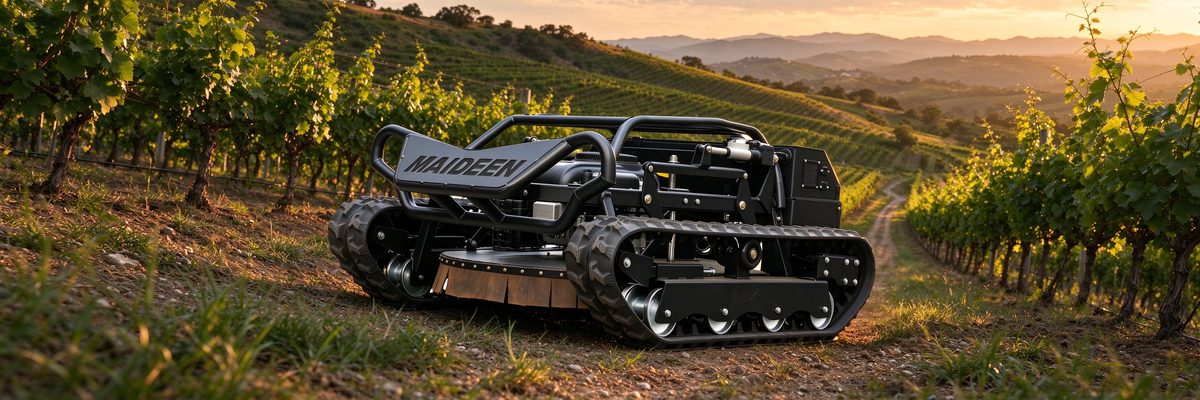
Global landscaping, land clearing and slope management markets keep expanding, and demand for mowers as core agricultural and forestry equipment is rising steadily. Mechanization and intelligent replacement are accelerating the retreat of manual weed control, and electric, petrol and remote-control mowers are now widely used in municipal landscaping, solar O&M, hillside orchards and river and highway embankments. Behind this rapid growth, however, long-standing weaknesses are surfacing at once — product shortcomings, homogeneous competition, poor working-condition fit, hard export compliance requirements and missing after-sales systems — seriously constraining quality growth and forcing the industry to iterate faster.
Poor fit to real working conditions, and the persistent difficulty of high-risk complex sites, is the industry's most central problem. Most mainstream wheeled and walk-behind mowers are suited only to flat lawns and fall short on hillsides, steep slopes, mud, potholes and stony wasteland. Grip and stability are poor and resistance to slipping and rollover is weak: on gradients beyond 15° they slip or tip easily, cutting efficiency sharply and creating serious safety hazards. Solar-station slopes, hillside cut faces and river embankment projects are high-risk areas where manual weed control carries a high fall risk, yet conventional machines cannot replace manual work — leaving the industry dilemma of "people dare not do it, machines cannot do it". Low chassis clearance and poor protection also mean thick grass, vines and gravel quickly wrap and block the machine, forcing frequent stops and delaying projects — unsuitable for heavy commercial land clearing.
Severe product homogeneity and worsening low-price competition have trapped the industry in low-end rivalry. As more players enter, large numbers of small and mid-sized manufacturers and assembly/rebadging firms have joined, most without independent R&D or innovation capability — no core technology, no field-test system, no quality standard — simply copying mainstream appearance and specifications while abandoning technical depth and quality improvement. To grab share, many compete on price, compress production costs and use thin steel, inferior parts and ordinary powertrains, sharply reducing durability. Many low-end machines suffer from deformable decks, fast-wearing tracks, fading power and unstable electronic control, with overheating, scoring and breakdowns under heavy load. Specification inflation, quality shrinkage and mismatched working conditions have become widespread, entrenching a vicious cycle that prizes price over quality and paper figures over field performance, while suppressing the market advantage of compliant, high-quality products.
Single-function products with low overall value cannot meet diversified demand. Most ordinary mowers do only basic mowing, which no longer fits modern agricultural and forestry maintenance. Orchard, municipal and solar O&M customers also need spraying, snow pushing and material handling, and single-function machines force them to buy several units — driving up purchase, storage and maintenance costs and lowering return on investment. Product fit is also polarized: petrol models are often noisy, high-emission and less environmentally friendly, struggling in strict markets such as Europe and North America; light electric models fall short on range for large-area clearing and long heavy-duty shifts. The imbalance between petrol and electric makes it hard to serve differentiated global conditions and policies.
High export compliance thresholds and barriers hold small manufacturers back. As green policies tighten worldwide, Europe, North America, Australia and Southeast Asia keep raising emission, safety and battery compliance standards, and CE, EPA and UN38.3 certification have become mandatory for export. Long certification cycles, high costs and strict technical standards mean many small assembly firms lack the qualifications and compliant products to clear customs, missing out on overseas growth markets entirely. Regulations also differ widely: Europe favors zero-emission and low noise, while Australia and the Middle East prefer high-power heavy-duty machines. A single model rarely fits all, and most companies lack the customization capability to match overseas demand precisely, making export expansion difficult.
Incomplete after-sales systems and high maintenance costs leave end users exposed. Industry surveys show more than 30% of users report high maintenance costs, with poor parts interchangeability and fast wear on low-end models. Most small and mid-sized manufacturers focus on sales and neglect service — no standardized parts inventory, no technical team, no long-term warranty system. When equipment fails, parts take long to source, repairs are difficult and technical response lags, disrupting work schedules and leaving users with little recourse and low repeat purchase. In export markets the gap is even wider: long cross-border logistics, high parts freight and missing local service leave overseas dealers and end users facing "easy to buy, hard to maintain", seriously limiting the international brand reputation of Chinese mowing equipment.
Industry analysts note that the mower industry is at a critical turning point. Low-end homogeneity, poor working-condition fit, weak compliance and missing after-sales service are both a bottleneck and an opening for quality source manufacturers. As the market gradually eliminates cheap, inferior assembly products, factories with independent R&D, full-condition capability, complete international certifications and systematic after-sales systems will break the current disorder and lead the industry from price competition toward quality, intelligence, scenario focus and internationalization — concentrating on the blue-ocean segment of complex, high-risk terrain and driving the upgrading and global expansion of Chinese agricultural and forestry equipment.